Showing posts with label Race Movies. Show all posts

Monday, February 9, 2015

The Blood of Jesus (1941) - Review


*WARNING: Use of GIF images*


Movie poster from Wikipedia


IMDb Summary

In the rural south of the United States, a godly young woman ("Martha Ann Jackson" played by Cathryn Caviness) is accidently wounded by her unchurched husband (Spencer Williams). She succumbs to the injuries, whereupon a good angel (played by Rogenia Goldthwaite) bids her to journey with him to the Crossroads of Life. Before she can travel far, the devil (Jas B. Jones) lures her with the temptations of juke joints and the city. Can she regain the straight and narrow before it's too late? And what is to become of those she left behind? 


Our Star of the Month, Spencer Williams made his directoral debut with The Blood of Jesus (1941). He also wrote and produced this film. Here are my thoughts:


Portrayal of the "Black Church"


Real-life preacher, Reverend R.L. Robertson & the Heavenly Choir


Religious themes (particularly "prodigal son" stories) were prevalent in most movies featuring all-Black casts. Hallelujah! (1929), Cabin in the Sky (originally a play), and Miracle in Harlem (1948) are just a few examples. In fact, The Blood of Jesus is very much like Cabin in the Sky. However, The Blood of Jesus still manages to stand out from the others.


************


For most African-Americans (especially during the years of slavery and well into...I'll say into the 1960s or 70s), Christianity and the Church were especially central in communities and individual lives. The church served as the soup kitchen, the schoolhouse, the dance hall (Rated G dancing, of course), the city hall, etc. It was versatile place that was always opened to guests. Even if you were a blues singer at the juke joint up the street, it was likely that you first started singing in church.


R.L. Robertson leads his congregation with "Sister Ellerby" (left) and "Sister Jenkins" by his sides.


Spencer Williams allowed that unique culture to shine in his script without making caricatures of African-American churchgoers. The cast members' prayer and worship didn't come off as an energetic screen performance. Even though actresses Juanita Riley and Reather Hardeman (as "Sister Jenkins" and "Sister Ellerby") played comedic roles, they too seemed honest in their praise to God. Speaking from a personal perspective, this showed the African-American church in a most natural light. 


*Further reading: Check out this link (scroll down a bit) to see how King Vidor (director of Hallelujah!) made the "connection" between African-Americans' sexual expression and religious expression. Although I still enjoy watching this movie, Vidor's observation of the "Black church" is a strange one--and it is apparent in Hallelujah!'s church scenes.


Writing

Race movie storylines were usually pretty simple. For the tight budgets didn't allow writers the opportunity to write scenes that would have required, say for instance, enough time for two brothers to tap, flip, and jump about in a large space. Instead, you'd get a familiar script with two or three musical acts thrown in to "spice it up". Not to mention that these acts were liable to perform at a tiny nightclub or at somebody's fictional rent party. Like the others, Spencer Williams stuck to a simple script for The Blood of Jesus and it did call for a "heavenly choir" and "jazz performers", but unlike the others, none of the musical performances seemed to be fillers.


Satan (Jas B. Jones) spots an angel (Rogenia Goldthwaite)


The Blood of Jesus makes a clear cut distinction between what gets you into Heaven and what sends you to hell: fast city life, fun outside of church, and wanting quick gratification=hell; waiting patiently for finer things/being thankful for what you have, seeking comfort in God, and friendship within the church=Heaven. Again, pretty simple. Some (myself included) may find the "black-and-whiteness" of such a storyline to be off-putting, but the film is grounded in some of the Bible's most often-cited teachings, after all. Even so, this didn't seem like a movie with a plan to convert people or get people to "get their house in order". It seemed to be Spencer Williams' way of making people relate to or understand the Bible in 1941.


Characters & Acting


There wasn't a bad performance in this film but there wasn't an exceptional performance, either. But again, simplicity was the key in this film. There was no need for anyone to chew the scenery. However, I think Spencer Williams (as "Raz"), Juanita Riley, and Reather Hardeman gave the more memorable performances.


Sister Martha Ann Jackson (Cathryn Caviness) having a good time


To fling synonyms of "honesty" around once again, I must applaud Spencer Williams for a genuine (or better yet, multi-dimensional) depiction of the African-American church congregation. While there was that distinction between what was "good" and what was "evil", Williams made certain that the characters weren't this precise. For example, his own character, "Razz", wasn't religious--and a character element such as that might tempt one to make Razz mean and nasty for the sake of being mean and nasty, but thankfully, Williams strayed far from this stereotype. The same could be said about other characters, including the lead character, Martha Ann. While Martha Ann strays away from the "straight and narrow" path for a bit, she doesn't go completely (and unbelievably) out of control. 


Sister Jenkins (Juanita Riley) catches Razz Jackson (Spencer Williams) in a lie. 


Overall Thoughts

Overall, I loved this movie. It's just under an hour long, but it didn't feel too short. As stated numerous times before, this a short, sweet, and refreshingly simple production--from the story to the cinematography and even down to the sound. Of all the Spencer Williams movies I've seen, I think this was his best. It's entertaining and it's also educational. Plus, if you ever spent time in "the church" or just in some rural areas in the United States' Southern region, this movie just may stir up some memories and nostalgia for you. It did that for me.


The Blood of Jesus (1941) on YouTube

Wednesday, December 17, 2014

Separate Cinema: Just in Time for the Holidays!


This past summer, I was extremely fortunate to receive an email from the publicist for ACC Distribution (Distributors of High Quality Books) asking me if I wanted a review copy of Separate Cinema: The First 100 Years of Black Poster Art. Of course, I was like "Heck yeah!" (that wasn't my exact reply, though). But to be completely honest, I had no idea what to expect. I thought a review copy meant a manuscript or Xeroxed copies of the book in a three-ringed binder (don't judge me). So of course, I was floored when received a "kinda heavy" package in the mail, and I was even more surprised when I opened the package and laid my eyes on one of the most beautiful books I'd ever seen.

BASICS


The movie poster art for 1943's Cabin in the Sky serves as the cover of this book.

As it is stated in ACC Distribution's product summary, Separate Cinema: 100 Years of Movie Poster Art is a must-have volume "celebrating the first 100 years of black film poster art". It is edited by archivist and founder of Separate Cinema, John Duke Kisch and Reel Art Press co-founder and editor, Tony Nourmand. It also includes a foreword by Dr. Henry Louis Gates, Jr. and an afterword by the great Spike Lee. 


Afterword by Spike Lee

The book was published by Reel Art Press and distributed by ACC Distribution. In its 320 pages, there are a total of 325 images--250 in color and 75 in black-and-white.


Published by Reel Art Press

APPEARANCE

The book's cover alone is one of the most physically appealing objects I've ever seen (it's so neat and inviting!). Then, once you get past the cover, your eyes are treated to classic movie poster art in its highest quality (high quality is what ACC Distribution accurately boasts). Separate Cinema: 100 Years of Movie Poster Art takes you on a seemingly unending journey of what may now be considered a dying (or probably even dead) art in the film world: hand-painted movie posters. Some of the images in these posters accurately capture the likeness of the movies' stars, while others simply slapped Uncle Remus, Little Black Sambo, and Topsy on them and said "Finis!", but I'm digressing...


A peek inside

CONTENT


Of course, this isn't just some large picture book. Also filling the pages is written history--sections that provide historical content to the movie posters that you're browsing through, and their respective movies as well. This history and context is provided by the sectioning of movie posters into certain categories. For example, movie posters for The Emperor Jones and Sanders of the River follow a mini-biography on Paul Robeson. Another example: the posters for musical shorts like St. Louis Blues (1929 and 1958) and Black and Tan (1929) are a part of a section titled "Jazz on Film". 


The aforementioned "Jazz on Film" section of the book

So while you're "oohing" and "awing" at the imagery, you're also reading up on Black American history as it relates to American Cinema. 


TRIGGER WARNINGS


There are no graphic images in this book. However, there are the unavoidable mentions of some of the dark, tragic, and racism-infused events of the United States' history.


WHERE TO BUY

Separate Cinema: 100 Years of Black Poster Art would be a great Christmas gift to a friend or a loved one. You could also purchase it for the coffee table of your own home and make it the "conversation piece" of your Christmas party!

You can visit Reel Art Press or ACC Distribution to purchase Separate Cinema: 100 Years of Black Poster Art.


************


Again, I want to thank ACC Distribution, particularly Ms. Burch, for graciously allowing me to preview this wonderful book. I also want to thank Mr. Kisch, Reel Art Press, and Mr. Nourmand for making this great collection of art and history accessible to us all. 

All of my love,
Adrienne 


************

*Photos taken by me, Adrienne, and shared for informational purposes only*


Saturday, November 29, 2014

That's Old News! (#10)


There's no video this time around, but this month's collection of articles are inspired by our featured star for the month of November, Mr. Lawrence Chenault. All of the articles below are on performers who appeared in race movies.

(Links to articles are attached to their respective titles)

************

The Afro American - Sept. 8, 1928


This previously shared article on Lawrence Chenault reports the details on the actor's sudden collapse after a stage performance. Mr. Chenault, who'd recently lost a good friend, ventriloquist Johnnie Woods, was ordered to rest for a year.


************

Arnold's 'Dope' From the T.O.B.A. Circuit
(by B.W.F. Arnold, Director of Publicity - T.O.B.A.)
The Afro American - Apr. 25, 1925


Evelyn Preer and Edward Thompson in The Melancholy Dame (1929) [posted by ~Kicha~ on ipernity]


Lafayette Players and real-life couple, Edward Thompson and Evelyn Preer, received praise for their work on the theatre circuit in this 1925 Afro American article!


************

The Afro American - Apr. 12, 1947


Dancer/actress Tondaleyo had been out of the spotlight for months before this article in The Afro American was published.


************

The Afro American - Apr. 6, 1929


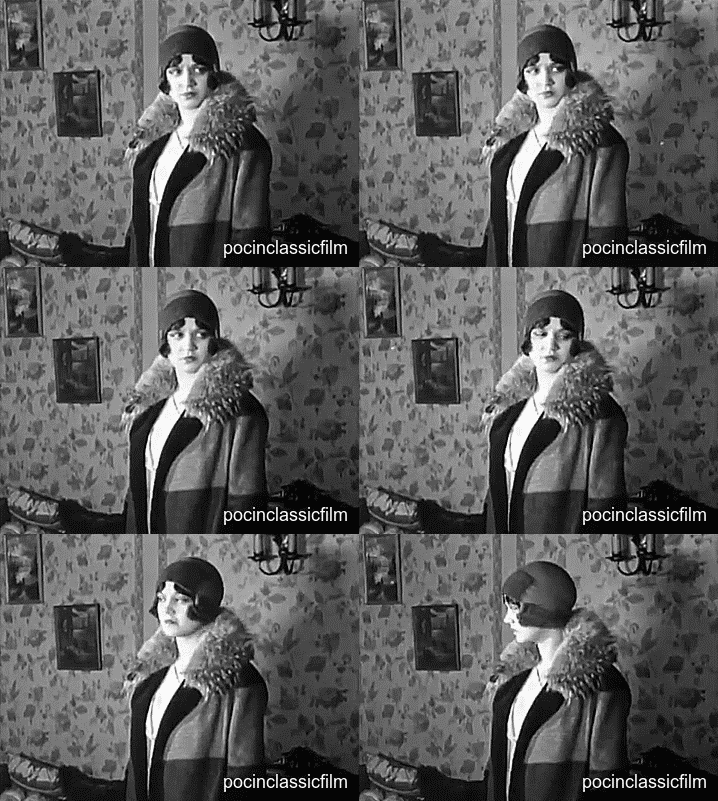
Lucia Lynn Moses in The Scar of Shame (1927)


Lucia Lynn Moses received rave reviews in Europe for her performance in The Scar of Shame. It appears that the Prince of Wales was quite taken with her beauty, as well.


************

Riding the Airwaves 
with Edgar A. Thompson (BCL)
Subheading: "Stepin Fetchit"
The Milwaukee Journal - Mar. 31, 1938 


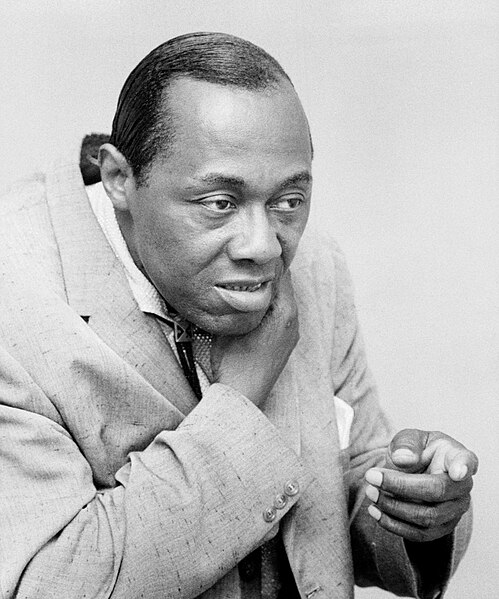
Stepin Fetchit in 1959 (from Wikimedia Commons)

Still a "star" of Hollywood at the time that this article was published, The Milwaukee Journal reported that the controversial actor would be appearing at a neighborhood playhouse with a band and an all-black revue. 


************

I hope you found this month's edition of That's Old News! to be quite informative! See you next month! :)

************

The images used in this post are being used for informational purposes only. If the rightful owner(s) of any of these images wishes to have them removed, please contact me, and I will do so.

--Adrienne

Thursday, October 16, 2014

Halloween with Aige


If you're like me and you don't particularly go out on Halloween, perhaps you could join me on Watch2Gether for a classic Horror movie marathon?


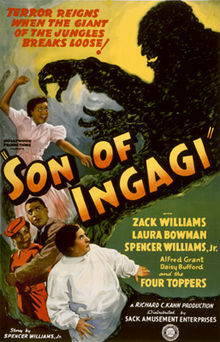
On Halloween night, I will be watching: The Devil's Daughter (1939), Son of Ingagi (1940), and Song at Midnight (1937). It's all happening on October 31st, beginning at 6PM EST. Will you join me?


Watch2Gether username: poccf_aige


Saturday, August 30, 2014

Separate Cinema: The First 100 Years of Black Poster Art


Here is a book to look out for!

From ACC Distribution


"This magnificent volume is a celebration of the first 100 years of black film poster art. A visual feast, these images recount the diverse and historic journey of the black film industry from the earliest days of Hollywood to present day. Accompanied by insightful accompanying text, a foreword by black history authority and renowned academic, Henry Louis Gates Jr., and an afterword by Hollywood director, Spike Lee."

Read more Separate Cinema: The First 100 Years of Black Poster Art and its author by clicking here. The coffee table book will be available this Fall.

Monday, August 25, 2014

That's Old News! (#7)


I hope you find these newspaper finds interesting and informative!


************

"Betti Mays Rose From Orphanage Ward to Become the Toast of Band Circles"


In May of 1947, The Afro American published a mini-biography of singer, dancer, actress, and bandleader, Betti Mays in their paper. I had no idea that Ms. Mays (who was also married to Ralph Cooper) was a bandleader! Click here to read the story of this multi-talented legend.


************

"Talented Ruby Dee Plays the Wife of a Neurosurgeon in 'Peyton Place'"


The late, great Ruby Dee appeared in 20 episodes of Peyton Place. Along with mention of her 1968 debut on the show, the Schenectady Gazette also gives a brief biography and mentions her "recently" completed role in Uptight!. Click here to read the article.


************

"Sheila Guyse Explodes Myth"


From the The New York Times

Journalist Walter Winchell was known as the entertainment industry's most feared journalists. He was known for exposing embarrassing or scandalous information about certain celebrities and government officials. Even the late singer and actress, Sheila Guyse was a target of Mr. Winchell at one point. Click here to read about a (dispelled) rumor published by Winchell and two other journalists--David Quark and Earl Wilson.


************

"Cab Calloway Tilt with Booking Agent Was Surprise to Broadway"


From Wikimedia Commons

Apparently, things got a little heated backstage at a Broadway show in August of 1940! Click here to read the Afro American article.


************

"Casting Begins for All-Sepia Mystery Film"


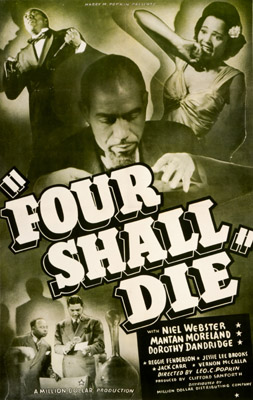
From Wikipedia

Casting for the 1940 film, Four Shall Die was announced just underneath the Cab Calloway article above. Click here and scroll down to read about the casting news. 


************

"Mantan Moreland says he's ready for serious roles now"


Mantan Moreland is probably best remembered for his role as "Birmingham Brown" in the Charlie Chan films. In the late 1950s, Mr. Moreland revealed that he wanted to "keep up with the times" and the industry's "growth"--and wanted to play more dramatic roles. Read more in The Afro American here.


************

Thursday, July 17, 2014

Black Shadows on a Silver Screen: My Thoughts!


I made the huge mistake of watching this documentary at the time that I watched it—at a point when my writing inspiration (a drama series screenplay) is at a "peak". Why was it a mistake? Because now I’m even MORE inspired! Inspired to write MORE scripts! I need a clone. 


This won’t be a "review". Not in the format that I usually do reviews in, that is. Instead, I will list my "Praises","Some Wrongs…", and "Overall Thoughts".

Screenshot of Title Card

************

Praise

  • This is probably a great documentary to show people who are just "getting into" race movies. It isn't an extensive documentary, but it highlights important people and monumental works. It was the bolded paragraphs of a long timeline being placed onto the screen, basically.


  • It's narrated by Ossie Davis. Enough said.


  • The documentary features audio of some unsung screen pioneers sharing their memories: George Johnson (actor, brother of Noble, and co-founder of the Lincoln Motion Picture Company), Lucia Lynn Moses, Fredi Washington, and Lorenzo Tucker. I was delighted to hear their voices—especially Lucia Lynn Moses'. For her only film was The Scar of Shame—a silent movie. 


  • We get a glimpse of lost and/or rare movies through still images and clips.


Some Wrongs...

  • I wanted to call this section "criticisms", but I realized that some aspects (or missing ones, rather) may have been out of creators' hands. I thought that the documentary should have covered more ground, but I also had to remember that it was released in 1975. Therefore, I will assume that at that time, a lot of race movies (notably Spencer Williams, Jr.’s movies) went unmentioned because they were believed to be lost. Oscar Micheaux's Body and Soul (1925) is referred to as his only surviving (or “known to survive”) Silent Era movie. Of course, movies like The Symbol of the Unconquered and Within Our Gates have since been recovered.


  • The documentary was supposed to be about race movies, but a few Hollywood movies (So Red the Rose, Hearts in Dixie, and Pinky) received their own little segments. This wasn’t supposed to be about Hollywood…or at least I thought it wasn’t. Also, Josephine Baker received her own segment, and she didn’t star in a single race movie.


  • I think that Josephine Baker and the Hollywood movies were acknowledged to serve as the contrast to race movies. “What was going on here—and what was going on over there…” but I felt that this took away from the race movies, its creators, and stars. 


  • Since the documentary did want to talk about Hollywood, there should have been mention of Hallelujah!. Although it wasn’t Hollywood’s first all-black talkie, it was released months after Hearts in Dixie—and along with Hearts in Dixie, it drove black performers to Hollywood. And speaking of Hallelujah!, I believe that Nina Mae McKinney was more deserving of her own segment than Josephine Baker, because she starred in Hallelujah! and eventually starred in race movies as well. 

Other movies and other stars that should have been mentioned: 


Many more! 


Overall (and personal) Thoughts

Again, I would recommend Black Shadows on a Silver Screen to people who are just getting into Black-American Cinema and/or race movies. People who’ve been exposed to a lot of race movies will notice the missing pieces and may be miffed by it like I was. However, as stated earlier, I did find inspiration in this documentary. 

I was reminded of why I started this blog and why it is important that I continue on the path that I am on. I love my history—the good and the bad, but especially the good. I hate seeing the potential in great movies being lost in low finances, but I’m grateful for the opportunities to see and hear the stories of these pioneering filmmakers and performers--people who looked like me. People who just wanted their people to not only seem themselves, but see themselves as whole and multi-dimensional.

I was inspired and humbled watching this documentary, and it my dream to make the mentioned and unmentioned stars and makers proud. :)


(on YouTube)


Thank you, Kyle! :)

Wednesday, June 18, 2014

Black Shadows on a Silver Screen


"Ossie Davis narrates a history of "race films," films made before 1950 which catered to a primarily black audience." [IMDb Summary]


This 1975 documentary is now available on YouTube for your viewing pleasure. Enjoy!


Saturday, May 31, 2014

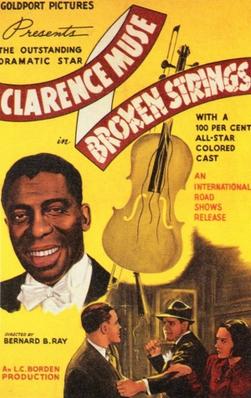
Movie of the Week: Broken Strings (1940) - Review


Broken Strings (1940) was the featured film for the week of May 19th-26th.

************

*Epilepsy Warning
Use of animated GIF images near bottom*

************


"After noted violinist Arthur Williams (Clarence Muse) suffers a hand injury which ends his playing career, his hopes are transferred to his son (Johnny, played by William Washington), who prefers swing music to classical." [IMDb]


************

Oh, the many race movies I've watched and thought "all it needed was a bigger budget..." This was the case with Broken Strings. The story wasn't new: classic/classical music lover hates the more popular music of the time; child wants to play that popular music. But different elements, such as, the instrument used (violin), secondary stories, and I'll say it--an all-black cast--gives the movie a special spin.


************

Story/Writing

Again, the storyline was simple, not exactly something fresh and new to the screen (a film with a similar storyline I can remember off the bat is 1938's Everybody Sing). However, the secondary storylines are what really "make" this movie--especially the ones that formulate after Arthur's hand injury. There's stubbornness, disobedience, jealousy, framing, deceitfulness, and even with all of this, the movie manages to not turn into something you'd see in a Murder-Mystery Dinner show. 

Nobody gets murdered, by the way.


Of course, all of those elements and additional storylines would require more time--and Broken Strings didn't have that, which serves as a negative for the film. Everything is rushed and jam-packed to this 60 minute movie, leaving very little time to let things cook before they're uncovered! Very unfortunate.


Characters/Acting

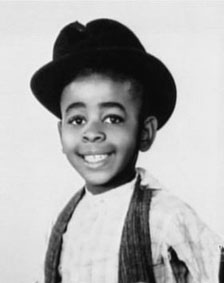
There wasn't one character that this film could have done without. Every major character had a purpose. As far as the acting goes, I'm going to come right on out and say that the only good actors in this movie were the more trained and seasoned ones--Clarence Muse, Matthew "Stymie" Beard (as Dickie Morley, a young, aspiring, but pompous violinist), and Edward Thompson (who is barely even in the movie). 


Young "Stymie" Beard

Everyone else...William Washington, Sybil Lewis (as Arthur's daughter, Gracie), Tommie Moore (as young pianist, Mary)...they all needed a little work. 


************

Honorary Mentions

It's always a treat to see Ms. Ruby Dandridge, who plays a small, but memorable role. Ironically, when Ms. Dandridge first came to Hollywood with her daughters in the early 1930s, she sought counsel from Mr. Muse on getting her daughters (Vivian and Dorothy) into movies. 

************

If you look very closely in one of the nightclub scenes (in fact, you don't even have to look closely, her face is unmistakable), you'll see the late Juanita Moore sitting down from a dance.

************

The Stevens Sisters

These talented little ones appear near the end of the film. I made animated GIF photos of them!


(Left to right): Charmaine, Cecile, Leonetti

The girls are singing a song called "Kentucky Babe"

Charmaine and Leonetti tap dancing

Little Cecile tap dancing


*I wonder where The Stevens Sisters are today?*


************

Directing/Cinematography

For the most part, Broken Strings was simply shot, but there were some cool effects added to keep the audience's interest--some Busby Berkeley-like kaleidoscope effects, tilted camera movements, faded images in the background--all things used to give the movie a "fantasy" feel. They also helped to create the sense that time was flying by (as if the movie needed any more of that). They didn't go overboard with these effects, either.


************

Overall Thoughts

I highly recommend that you watch Broken Strings. Bad acting aside, it is very entertaining. In fact, it ranks pretty high on my list of great race movies.


*Broken Strings (1940) on YouTube*
(Animated GIF images created from ^this^ link)

Sunday, May 25, 2014

Movie of the Week: The Scar of Shame (1927) (Review)


The Scar of Shame was the featured film for the week of May 12th-19th.

*Epilepsy Warning: 
Use of animated GIF images*

************

From Wikipedia


An educated, upscale young black musician (named Alvin Hillyard - played by Harry Henderson) marries a woman (Louise Howard - played by Lucia Lynn Moses) from a lower socioeconomic class to get her out of the clutches of her stepfather ("Spike" Howard - William E. Pettus), who beats and abuses her. However, once he "saves" her, he won't let his new wife meet his mother, as he knows she will be angry and disappointed with him for marrying someone "below his station". [IMDb]

Oh, there's so much more to this film than that IMDb summary, but going any further would require some spoiler alerts. 


************ 

Story/Writing
Screenplay by David Starkman (also the producer)


Alvin (Harry Henderson) consoles Louise (Lucia Lynn Moses)

There really isn't much I have to say about The Scar of Shame's writing. As far as the plot goes, it nicely written and played out very well. The few problems I did have--problems having to do with social issues--will be discussed in my 'Overall Thoughts'.

************

Characters/Acting

Like the storyline, this movie's characters were very well written. They were multi-dimensional, they were genuine, and they were human. Of course, you had your protagonists and antagonists, but no one was "all good" and no one was "all bad". There's one character who isn't mentioned in the summary--a very important character, actually. His name is Eddie Blake (played by Norman Johnstone) and he's a friend of Louise's father who devises a scheme to break up Louise and Alvin's marriage.


Eddie Blake (Norman Johnstone) wants to "talk" to Louise)

This particular character is more of an antagonist than the abusive father, but at one point (a very small point), we see a little inkling of guilt in his face. I liked that--he was a bad guy with a conscience, but not so much of a conscience that he would unrealistically do a "180" to make amends. At least, not at the drop of a hat. This is pretty much how the majority of the characters were written.


Direction/Cinematography

Both director (Frank Peregini) and cinematographer (Al Liguori) paid great attention to detail for The Scar of Shame--and it's very obvious. They made great use of the motifs and the editing was seamless. Like the writing, this is another aspect of the film I really don't need to go on and on about--it was all good. Throw up my "OK" sign, good. 


One of the symbol's of the film's recurring theme.

I might also add that the director and producer--both white--probably had better budgets and backing than the Oscar Micheauxs of early American Cinema.


************

Overall Thoughts

Obviously, I enjoyed watching this movie. I would definitely watch it again. In fact, I can see myself watching it very often. However, I must point out the things that bother me--and I will try to do so without spoiling anything:

The character, Louise, is abused, misused, and disrespected throughout this film. When she starts lashing out at those who mistreat her, she is made out to be the "wrong" one. As I'm writing this, I still feel a little irritated. Louise deserved nothing but great things and (*cue my accent*) it was some bull that she didn't git 'em, eitha.


The point in which Louise stopped caring--or at least pretended to.

Also, the film seems to serve as a commentary on class, particularly the separation of class within the black race. It acknowledges negative attitudes and personalities that dwell in both upper class society and lower class society. However, the problems with classism--and the bad ways in which people from different backgrounds interact--are placed solely on members of the lower class in The Scar of Shame. Of course, Louise's father and Eddie Blake bring Louise physically and emotional harm, but Alvin's failure to correct his mother's snobby attitude (and the snobby attitude itself) plays a big part in the unraveling of Louise's life and sanity, as well--and neither Alvin nor snobby thinking were held accountable in the screenplay. 

******

To reiterate, despite the aforementioned flaws, I still enjoyed this movie, and would definitely watch it again and again.

 I recommend that you watch it as well!

*The Scar of Shame on Youtube*

(All gifs used in this post were created using ^this^ video link)


************

The images used in this post are being used for informational purposes only. If the rightful owner(s) of any of these images wishes to have them removed, please contact me, and I will do so immediately. 

--Adrienne