Showing posts with label Racism. Show all posts

Tuesday, May 5, 2015

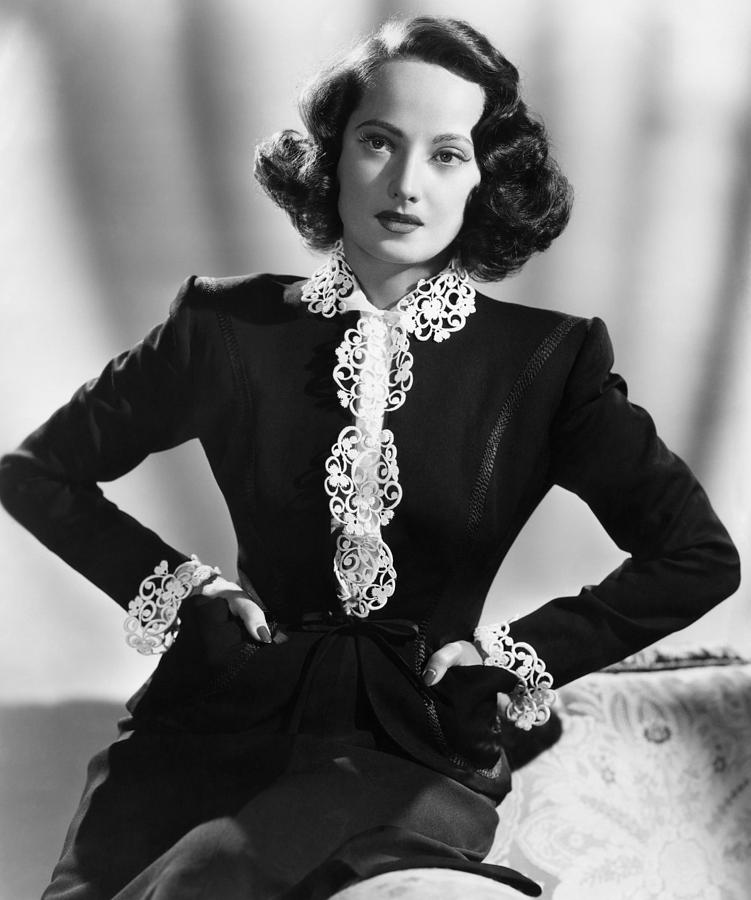
Merle Oberon stands alone...


This weekend, I had the pleasure of watching April 2015's featured star, Merle Oberon, in The Dark Angel. Oberon received the 'Best Actress' nomination for her performance in this movie and eight decades later, she is still the only woman of Asian descent to be nominated in the category. I will get to that later.


Source

"Kitty Vane (Merle Oberon), Alan Trent (Fredric March), and Gerald Shannon (Herbert Marshall) have been inseparable friends since childhood. Kitty has always known she would marry one of them, but has waited until the beginning of World War I before finally choosing Alan. Gerald graciously gives them his blessing. Then, Gerald and Alan go to war. Angered over a misunderstanding involving Alan and Kitty, Gerald sends Alan on a dangerous mission that will change all their lives forever." [IMDb Summary]

*************

Overall Thoughts

1935's The Dark Angel is the second film adaptation of Guy Bolton's play of the same name (the first movie was released in 1925, the same year the play premiered on Broadway). I'd previously been unfamiliar with the play, but if it's anything like the 1935 movie (not altered too much for the screen), then I will say that The Dark Angel is one of the 20th century's most beautifully written works. The 1935 movie is the kind of movie that manages to be both familiar and refreshingly unique at the same time.

Guy Bolton, writer of The Dark Angel

It's a love story--we're familiar with that. Boy meets girl, boy loses girl, boy gets girl back, that kind of thing--but as is needed for all movies with familiar plots, there are complications thrown in to make it stand out--and this movie had all of that and more! It's very unfortunate that it wasn't nominated for Best Picture (or "Outstanding Production", rather).

The Dark Angel will make you chuckle--it will also frustrate you--and as any good romance/drama does, it will make you cry. The characters are written so beautifully: my favorite thing about them is that they were so in-sync with each other's emotions--they all knew when something was wrong with each other. They rarely expressed their feelings vocally and they rarely reacted vocally to each other's feelings, either. That my friend, is the stuff that makes screenwriting (and writers) great. 

Lillian Hellman, one of two screenwriters for The Dark Angel (1935). The other was Mordaunt Shairp.


It's also unfortunate that Fredric March didn't receive a Best Actor nomination (the 'Best Supporting' categories weren't awarded until a year later). He too, gave a fine performance. 


************

Merle Oberon standing alone...


Source

Merle Oberon was the first person of Asian descent to be nominated for an Academy Award--and since her nomination in 1935/1936 (the awards ceremony was held in 1936), no other woman of Asian descent has been nominated for 'Best Actress in a Leading Role'. Eight decades. Eight years

Over the last few years, I've had to wonder: "Should people of color strive for Oscars and other "mainstream" awards?" "Should these awards really be an end-goal for filmmakers and performers of color?" There are two (and probably more) ways to look at this: 

First, it isn't wise to work for awards. If you love what you do, you typically won't care too much about the awards you do or don't receive. However, imagine what it's like to work in the same office for years and never be recognized for your work! Imagine how daunting it is when you constantly meet the criteria for an assignment (or an award) and you're constantly overlooked (see white actors being cast as Asian characters; see Ava DuVernay being snubbed for the 'Best Director' Oscar-nomination for Selma; see Fruitvale Station's star and director (Michael B. Jordan and Ryan Coogler) being invited to "major" awards shows but receiving no nominations for said major awards). 

With all of that said, while it is important for us to recognize the Asian/Asian-American artists who don't make it in Hollywood--because they are also important and their work is still worthy--I think that it is just as important to recognize the ones who are there. As long as people of color live and work in Hollywood, there is absolutely no reason why the majority of them should still be fighting for elbow room. It's like owning a boardinghouse, taking rent from ten boarders, but only cooking dinner for five of them--and telling the other five have to go out every night and find their own meals.

Source

Eighty years later, Merle Oberon should not be the only actress of Asian descent to be nominated for the 'Best Actress' Oscar. Eighty years later, she should not still be the only Asian actress who obtained a role deemed Oscar-worthy.

Do you want to know what's even scarier? If the "secret" of Merle Oberon's background hadn't been revealed after her death, NO woman of (known) Asian descent will have been nominated for 'Best Actress' in the 87 years of the Academy Awards' existence.


************

With all of that said, I do recommend that you all watch The Dark Angel (1935). Revel in Merle Oberon's talent and beauty.


Wednesday, August 28, 2013

The Best of People of Color in Classic Film (One Year Later)


Here is a list of the Top 10 most viewed posts (in order of least popular to most) since Monday, August 27, 2012:


10.

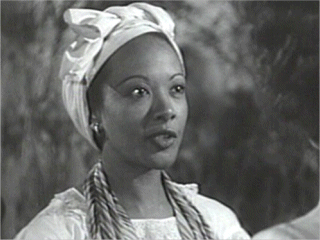
Theresa Harris: The Beautiful Maid

Last November, I made a post saluting the unsung Hollywood actress, Ms. Theresa Harris. This post has been viewed 141 times.


9. 

The Stereotypes of Latino Men
(Was originally posted as "Hispanic Men")

People of Color in Classic Film used to have "Monthly Themes". Our second theme recognized the stereotypes of Latino Men in Hollywood film. Here is the post introducing that theme--viewed 166 times.


8.


Theme One: The Good Earth (Review)

Our first monthly theme examined the use of white actors in the roles of Asian (particularly East Asian) characters. In September of 2012, I watched and reviewed MGM's The Good Earth. This review has garnered 171 views.

7.

If Ethel Were Chick...

This past June, I touched on (sort of "feathered against") the colorist standards held against black women (particularly dark skinned black women) in Hollywood and society by posing the above question. Ironically, although this post has been viewed 220 times, there has been little interaction in the comments. 


6.

Biopics That We Need (Women)

Back in March (on the last day of Women's History Month) I made a slideshow featuring a list of women (actresses and singers) that I believed deserved biopics--and I even matched them up with actresses I thought should play them. This post has garnered 230 views. 

(By the way, I'm currently working on one for the men.)  


5.

Theme One Summary (Labor Day Post)

In September of 2012, I introduced the first of the "Monthly Themes" and it was titled "Asian Characters...No Asian Actors, Please!" This particular post merely summarized what the theme would be about, but it has been viewed 251 times.


4. 


Ladies of Color on Youtube (Part I)

In this post, I made a list of movies available on Youtube that starred women like Anna May Wong, Josephine Baker, Dorothy Van Engle, and more. The list has been viewed 283 times.


3.

National Hispanic Heritage Month

I merely recognized this special month in a short, summarizing post, but nonetheless, this post has garnered 343 views since September 15, 2012.


************

2. 

Happy 90th Birthday, Dorothy Dandridge

November 9, 2012 would have been Dorothy Dandridge's 90th birthday and I was elated to know that she had not been forgotten and she certainly is loved everywhere. As of today, this post has been viewed 526 times. 


************

Finally, what was the most viewed post on People of Color in Classic Film on Blogspot???

1.


Theme One: Mr. Yunioshi 
(Breakfast at Tiffany's Review)


This post has been viewed 776 times. As apart of the "Asian Characters...No Asian Actors Please!" theme, I reviewed and examined one of the most controversial portrayals in Hollywood history.


************

Honorable Mentions

Before this blog became "People of Color in Classic Film", it was (blandly) called "Aige: Film and Television". There are a few posts under that name that deserve some recognition:


Margarita Carmen Cansino (Rita Hayworth)

In this post, I expressed my budding love for Hollywood star, Rita Hayworth and I questioned what her legacy would be like had she not had certain alterations done. This post has been viewed 416 times.


The Screen's Unsung: Vivian Dandridge (Part One)

Every week, during the Aige: Film & TV days, I recognized an unsung person of the screen. Vivian Dandridge was one of those people. This post has garnered 575 views.


Let's Talk: Judy Garland

Some time after what would have been Judy Garland's 90th birthday, I made a very sentimental post about her life and legacy. It's been viewed 688 times.


************


Below are the two most viewed posts of this entire blog--I mean "Aige: Film and Television" and People of Color in Classic Film......


Let's Talk: Dorothy Dandridge & Marilyn Monroe
Part One and Part Two

In this two part post, I examined the careers and legacies of two often compared screen legends to help myself and others better understand why one has been praised and admired more than the other (the answer was quite simple, yet intricate). 


Part One has been viewed 1,205 times and Part Two has been viewed an amazing 2,119 views. 


************

I feel very good about this amazing list and am ready to continue marching onto the road ahead. Thank you all for your love and support. Thank you so, so much.

Love,
Adrienne

************

Speaking of marching, how will you be celebrating the 50th Anniversary of the March on Washington today? Anybody off to or in D.C.?


All of the images used in this post were obtained from Wikipedia and are all believed to be in the Public Domain. If the rightful owner of any of these photos wishes to have them removed, please contact me and I will do so immediately. 


Friday, July 19, 2013

Stars of Color: Blacklisted!


The Hollywood blacklist—as the broader entertainment industry blacklist is generally known—was the mid-20th-century practice of denying employment to screenwriters, actors, directors, musicians, and other U.S. entertainment professionals because of their suspected political beliefs or associations. Artists were barred from work on the basis of their alleged membership in or sympathy with the American Communist Party, involvement in progressive political causes that enforcers of the blacklist associated with communism, and refusal to assist investigations into Communist Party activities. Even during the period of its strictest enforcement, the late 1940s through the late 1950s, the blacklist was rarely made explicit and verifiable, but it caused direct damage to the careers of scores of American artists, often made betrayal of friendship (not to mention principle) the price for a livelihood, and promoted ideological censorship across the entire industry. [Wikipedia

The driving force behind the second "Red Scare", Sen. Joseph McCarthy.

This was a scary time for U.S. entertainers and artists, especially (and "ironically") for those who were outspoken advocates of equality in America. In this post, you will find a list of entertainers of color who were "blacklisted", why they were blacklisted, and what it did to their careers......

************

Canada Lee


Canada Lee was born Leonard Cornelius Canegata on March 3, 1907 in New York City. Before becoming an actor, Mr. Lee had tried his hand in music (he was a concert violinist by the age of 12), horseback riding, and boxing (a blow to the eye would end his boxing career and leave him nearly blind). He would go on to have a successful career in theater (while applying for a job at the YMCA, he stumbled upon an audition in progress and was invited to try out, thus earning a supporting role in a play), and then, a successful one in film. 

Along with being an excellent actor, Canada Lee was also an outspoken activist for Civil Rights in America and in South Africa as well. By around 1949, Lee's outspokenness and contact with "alleged" Communists (particularly his good friend, Paul Robeson) got him placed on Hollywood's Blacklist. In 1950, he and Sidney Poitier were smuggled into South Africa as indentured servants in order to shoot what would be his final film, Cry, the Beloved Country. Mr. Lee had a heart attack while shooting the movie and never fully recovered from it. He died of another heart attack on May 9, 1952 at the age of 45. 


More Information: 
Blacklist: Recovering the Life of Canada Lee (Documentary) (Website, IMDb page), 


************

Paul Robeson

From last.fm


Paul Leroy Bustill Robeson was born on April 9, 1898 in Princeton, New Jersey. Robeson and his four siblings were raised singlehandedly by their father, a Presbyterian minister (their mother had died in a house fire when Paul was six years old). The foundation for Robeson's legendary vocal skills were laid in his father's church. At the age of 17, the 6'3" high school fullback earned a scholarship to attend Rutgers University (only the third Black-American to be accepted to the school) where--despite racial hate from other students--he would excel as an athlete, join the debate team and the Glee club and graduate with multiple high honors--including class valedictorian. 

In Fall 1919, Robeson would enter NYU's School of Law, but later transferred to Columbia's Law School. By this time, along with being a popular athlete, Mr. Robeson was also an established singer in the black community, and had made his theatrical debut while still in law school. His theatrical debut would lead him into more theater roles, on-and-off Broadway, and into his film debut in Oscar Micheaux's 1925 film, Body and Soul. Paul Robeson never practiced law, but went on to become one of the country's most revered entertainers--that is, until about the 1940's...

The 1940s was a mixture of performance triumphs and poignant, political upheavals. While his title run in the musical drama John Henry (1940), was short-lived, he earned widespread acclaim for his Broadway Othello in 1943, opposite José Ferrer as Iago and Uta Hagen as Desdemona. By this time, however, Robeson was being reviled by much of white America for his outspoken civil rights speeches against segregation and lynchings, particularly in the South. A founder of the Progressive Party, an independent political party, his outdoor concerts sometimes ignited violence and he was now a full-blown target for "Red Menace" agitators. In 1946 he denied under oath being a member of the Communist Party, but steadfastly refused to refute the accusations under subsequent probes. As a result, his passport was withdrawn and he became engaged in legal battles for nearly a decade in order to retrieve it. Adding fuel to the fire was his only son's (Paul Jr.) marriage to a white woman in 1949 and his being awarded the Stalin Peace Prize in 1952 (he was unable to receive it until 1958 when his passport was returned to him). [IMDb]

Robeson originally had no intentions of leaving America, his home, but when worked dried up, he went to Europe and was warmly welcomed into their entertainment circuits. Although he was able to find success in Europe, Robeson still battled with depression and other health problems. He returned to the United States in 1963, still in poor health, but still speaking out against discrimination. Paul Robeson died on January 23, 1976 at the age of 77.

Sources: Wikipedia, IMDb

More Information: Wikipedia


************

Lena Horne


Lena Mary Calhoun Horne was born on June 30, 1917 in Brooklyn, New York. Her parents divorced when she was three, and her mother--an actress--traveled all over the country as part of many theatre troupes. Lena was mainly raised by her paternal grandparents, but sometimes would accompany her mother on the road. At the age of 16, Horne dropped out of high school and joined the chorus line of Harlem's Cotton Club. A few years later, Lena joined the Noble Sissle Society Orchestra (using the name "Helena Horne"). Within a short time, Lena had become one of New York's most popular and sought-after vocalists. 

She made her film debut in a "race movie" musical, The Duke is Tops in 1938 and in 1942, she'd signed a long-term contract with Metro-Goldwyn-Mayer, but unfortunately--as was the case with most actresses of color--MGM had a hard time casting Lena and her work in Hollywood quickly fizzled out. By the end of the 1940's, Lena Horne had become known as an outspoken advocate for racial equality in the entertainment industry. Her outspokenness, membership with the Progressive Citizens of America (a leftist group), and affiliation with Paul Robeson got her blacklisted in Film, Theatre, and Radio. She returned to working in nightclubs and found a huge amount of success there. 

Lena Horne had a long-lasting career in nightclubs and on Broadway. She'd return to the movies in 1956, not too long after being blacklisted, and made many television appearances after. Ms. Horne disappeared from the public eye in 2000 and passed away on May 9, 2010 at the age of 92. 


Sources: Wikipedia, IMDb, Biography


************

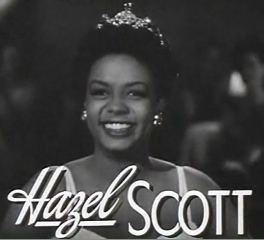
Hazel Scott


Hazel Dorothy Scott was born on June 11, 1920 in Port au Spain, Trinidad. Under the guidance of her mother, she began playing the piano at the age of three, and when she was four, the two moved to New York with other family members. At the age of eight, Hazel would receive scholarships to attend the Julliard School of Music, then as a teenager, she would play in her mother's all-girl Jazz band. 

By the time she'd reached her late teens and early twenties, Hazel Scott had become a a star attraction in nightclubs and on radio. By 1945, she was earning about $75,000 a year (over $900,000 today). She'd also made appearances in a few Hollywood pictures as well. In 1950, Hazel Scott became the first woman of color to host a network television show in the United States with The Hazel Scott Show, a 15-minute musical program that was produced and distributed on the DuMont network. 

However, like the people mentioned above, Hazel Scott frequently spoke out against racial discrimination in America and openly spoke out against McCarthyism. Hazel's outspokenness got her labeled as a Communist-sympathizer, and despite high ratings and positive reviews, The Hazel Scott Show was cancelled. She left the U.S. for Paris in the late 1950's and wouldn't return until 1967. She made a few television appearances upon her return and continued working in nightclubs until her death (of cancer) on October 2, 1981. 

Sources: Wikipedia, IMDb


************

Rosaura Revueltas

From Onda Cultural


Rosaura Revueltas Sánchez was born on August 6, 1910 in Lerdo, Durango, Mexico. She was little sister to composer, Silvestre Revueltas and painter, Fermín, and big sister to writer, José.

Revueltas studied acting and ballet in Mexico City and would soon join dance companies, dancing on stage, and later in Film. In 1950, she was cast as a seventy year old woman in the Emilio Fernández film, Un día de vida, a role that nabbed her an Ariel Award nomination (the Mexican equivalent to the Oscars) for Best Supporting Actress. 

In 1954, despite warnings, she accepted the role of Esperanza Quintero in the independent American film, Salt of the Earth. The pro-union labor film would become the only blacklisted film during the "Red Scare"--much of the film's cast and crew would also find themselves on Hollywood's blacklist, including Revueltas. She would be imprisoned in the United States and eventually deported to Mexico. She never made another film the United States. She moved to Germany in 1957, then returned to Mexico in 1960.

Rosaura made her final film in 1977 and would spend the rest of her life judging Film festivals, teaching dance classes and yoga classes. She published her family's biography, Los Revueltas: Biografía de une familia in 1979Six months after being diagnosed with lung cancer, Rosaura Revueltas passed away on April 30, 1996. 

Sources: Wikipedia, IMDb, Cineforever 

More Information: Cineforever, New York Times, LA Times, Here's Looking at You (Google Books)


************

Ossie Davis and Ruby Dee

Photo from Black Love Forum

Raiford Chatman Davis was born on December 18, 1917 in Cogdell, Clinch County, Georgia. The county clerk misunderstood his mother's dialectal pronunciation of his initials, "R.C." when he was born. He thought he heard "Ossie" and registered him as such, and the name stuck

Ruby Ann Wallace was born in Cleveland, Ohio on October 27, 1924. Ruby, a Hunter College graduate who'd been raised in Harlem, would begin her acting career on the stage in 1940. She married blues singer, Frankie Dee, in 1941, and of course, even after divorce she'd continue using his last name for her flourishing career. 

After dropping out of Howard University in 1939, Ossie Davis would begin his acting career that same year with the Rose McClendon Players in Harlem (later, he'd attend Columbia University School of General Studies). 

The Davises married in 1948 and often worked together on the stage and in film. In fact, Ossie made his film debut with Ruby in 1950's No Way Out. As the two worked constantly, they were also well-known Civil Rights activists, joining many organizations that fought against racial discrimination, and were also good friends with Malcolm X and Martin Luther King, Jr. Of course, such activism was considered a threat during the McCarthy era:

"The McCarthy years cut so much out from under us," he (Ossie) says.
For a period, they were blacklisted. They survived McCarthyism, though FBI agents trailed them around; they suffered the pain of being out of work, and remained determined to keep raising money for families of lynch victims. [Washington Post, 2004]

Fortunately, unlike many other blacklisted entertainers and writers, Ossie and Ruby were able to successfully make their way back into the entertainment world and continued working nonstop--together and solo--thus establishing themselves as living legends and as one of Black America's power couples. Ossie Davis passed away on February 4, 2005 and Ms. Ruby Dee is still working hard as ever. In 2007, she became the second oldest nominee for the Best Supporting Actress Academy Award (Gloria Stuart was the oldest, nominated for her role in Titanic at the age of 87) for her role in American Gangster (2007). It was her first Oscar-nomination. 


Sources: Wikipedia (both), IMDb (both), Washington Post

More Information: "Ossie Davis and Ruby Dee Blacklisted" (Google Search results)


Questioned Stars of Color

Fredi Washington
Born to Be Hurt (Google Books; pages 368-369)

José Ferrer
Hollywood's Blacklists: A Political and Cultural History (Google Books; pages 113-114)


*Countless others*


************

Unless noted otherwise, all images used in this post were obtained from Wikipedia and are believed to be in the Public Domain. If the rightful owner(s) of any of the above images wishes to have them remove, please contact me and I will do so immediately.--Adrienne



Monday, April 29, 2013

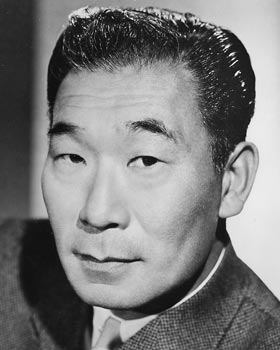
"Philip Ahn, you speak English too well."


From LA Times


Philip Ahn was in high school when he visited the set of The Thief of Baghdad. The movie's star--Douglas Fairbanks--offered him a small, uncredited role--thus beginning a career that would span over five decades and give him over 180 acting credits. He was almost rejected for his fifth role for an appalling (but not surprising) reason...


The film was 1936's Anything Goes starring Bing Crosby and Ethel Merman, directed by Lewis Milestone: 

"Director Milestone turned down Philip the very first time they met because Ahn's English was too good. On his way out of their first meeting, Philip, with great humor, mimicked a heavy Asian accent perfectly and got the job immediately." [Source]


What a testament to the workings of Old Hollywood (and even Hollywood today). Throughout the remainder of his career, Mr. Ahn would play a lot of Japanese villains (even though he was Korean-American) and mysterious, speakers of proverbs.

Philip Ahn as Master Kan in the series Kung Fu.

How would you compare the roles of Asian/Asian-American men in Hollywood films? 

Would you say they've gotten better over the past say...70 years? Worse? Or have they pretty much stayed the same?

Sources


Wednesday, February 20, 2013

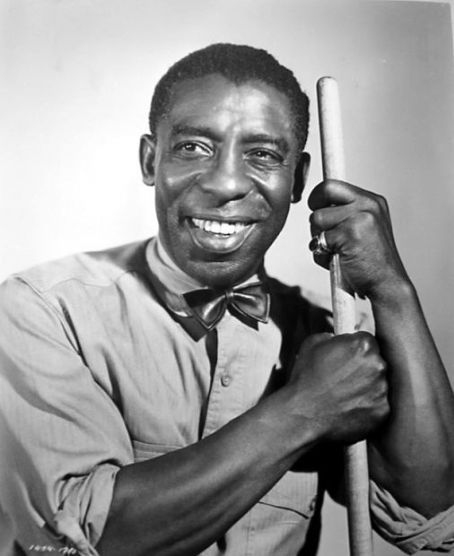
Clarence Muse, Man of Principles


Not only did the great Clarence Muse blaze trails for African-Americans in front of the camera, but he also fought to make some changes behind the camera. 


"He [Clarence Muse] spoke out early against the use of the word ‘n***er’ on movie sets to describe a device used to dim lights. Eugene Jackson recalled the day at Fox Studios when Muse heard a technician say “Bring that n***er over here.” Both shocked and angered, the actor immediately spoke to the director, who explained what the term meant. But that didn’t satisfy Muse. Finally, according to Jackson, production that day was closed down. “Clarence, being a man of high principles and standards, would not back down,” said Jackson. “He stuck to his guns, his beliefs, until a change was made. I was merely a youth, but I was taught something that day that has stayed with me all of my life: if you know and believe in your heart that something must be changed, act on it."


I enjoy reading stories like this about great pioneers like Mr. Muse. Certainly a fine example for any African-American entering the world of Hollywood.


Sources

Bogle, Donald. Bright Boulevards, Bold Dreams: The Story of Black Hollywood. New York: The Random House Publishing Group: 2005. Print. 


Photo Two: A Cinema Apart

Sunday, November 11, 2012

Theresa Harris--The Beautiful Maid


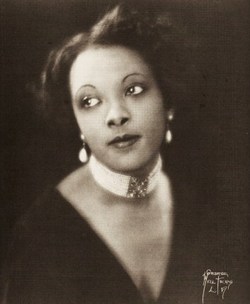
Theresa Harris worked alongside more stars of Hollywood's Golden Era than anyone else and was known as "The Beautiful Maid". She was one of the few women to play the servant role without "looking the part". 

(Actress Mildred Washington was also known as "The Beautiful Maid")

Unsure of source; possibly from Vintage Black Glamour

Her most memorable work came from the "Pre-Code" era. This era of no rules (or no code) allowed Ms. Harris to be more than "just a maid" (depending on who you ask) to her white female employers. In fact, she often outshone the stars of these films--even after  the Pre-Code era.

Photo from MadameNoire


Watch Ms. Harris in her first film role--an uncredited singing role in the 1929 film Thunderbolt.


To learn more about Theresa Harris:
Check out her IMDb page.

Also, read this interesting article about her in the New York Times.


Tuesday, October 30, 2012

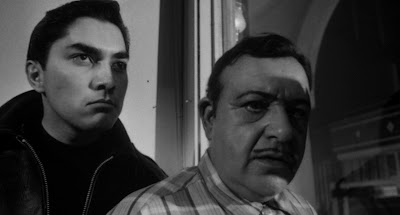
Portrayal of Mexican Men in "Touch of Evil"


Last week I watched Orson Welles' Touch of Evil in one of my film classes--a Film Noir.

Right off the bat I began noticing a negative portrayal of the Latino man. 


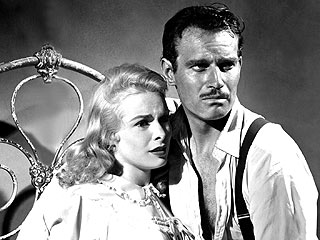
The film stars Charlton Heston as Mike Vargas, a Mexican government official (in brownface and all), Orson Welles as crooked official Hank Quinlan, and Janet Leigh as Mike's bride, Susie. 


Mike Vargas is the good guy, so of course it was only right that a white actor was hired to play the role.

As mentioned before, this is a Film Noir--filled with crime, violence, drugs, and sex. In this particular film however, sex is presented to us in what could be conceived as a racially charged way.

From the start, it is made clear that Susie is to become the target of the Mexican characters' lust. Throughout the film, her personal space is constantly invaded by the Latino men--at one point the character "Uncle Joe" licks his lips in a sort of sleazy kind of way when Susie walks away from him. 


Near the climax of the film, it is also strongly suggested that Susie is about to be raped, as a large group of both men and women (one woman stating "I wanna watch...") surround her and stare at her with menacing eyes--as she lies helplessly on a bed. 

Although it is unclear (to me anyway) if that was a part of what happened, the implication was strong to me and my classmates as well. 


I recommend that you see Touch of Evil(1958). I think it was a pretty good movie--it lived up to its genre. It got a little crazy towards the end, but it kept my interest throughout. 


What are your thoughts on such portrayals of Latino men--or any other man of color?


Photo Sources:

http://t3.gstatic.com/images?q=tbn:ANd9GcR2HcflyLSD8YsdSXm2y_MCGhkZ8PkQ9ZJUWUAW8nzFrNvXY_TSXAXB4yuvzQ

https://blogger.googleusercontent.com/img/b/R29vZ2xl/AVvXsEjHlFYBq-ZYj8BGzrQHFM-Oh9h76vo06OL2PxPKaliUINcp0uts2hyphenhyphentDpxI7t91cOeb6WodeXFBF3qm_5qsSPRC3nPiLihQu2N2ZUQlTDVRlZ7OLxrEr3TawoxhPqwgzpNtdGLiu7jbSdw/s400/Touch+Of+Evil+100.jpg


http://www.betterlivingthroughbeowulf.com/wp-content/uploads/2011/02/heston.jpg

http://thumbs.anyclip.com/tG3FUwjmx/tmb_388_480.jpg


Monday, October 1, 2012

The Stereotypes of *Latino Men


Brace yourself for one of the corniest analogies in corny analogy history:

Think of Hollywood as a good ole American Apple Pie (with a fancy topping for that Hollywood glam). Many things make up that pie and I like to believe that racial stereotypes have been one of that pie's most important ingredients--without them, Hollywood as we know it just wouldn't be the same. Of course, this isn't a good thing, but while some of Hollywood's most groundbreaking films were changing the face of Hollywood, some of them were also dripping with racism--The Birth of a Nation being the leader of the pack. 


This month, I want to focus on some of the stereotypes of Hispanic Latino Men in Hollywood--especially Mexican men. Terms like "Bandito", "Greaser", "Latin Lover", "Macho", and "Buffoon" have been used to describe *Latino men in Hollywood movies (and unfortunately, in real life). 

Rudolph Valentino, Italian/French actor known as the "Latin Lover".

I will be post as much as I can about the movies that display these stereotypes and I will also post information on some of the actors that have worked in these movies. 

Alfonso Bedoya in The Treasure of the Sierra Madre


As always, I want you all to feel free to leave any comments--make suggestions, corrections, etc. all throughout this month.

Thank you so much,
Aige <3