Showing posts with label Black Cinema. Show all posts

Wednesday, December 17, 2014

Separate Cinema: Just in Time for the Holidays!


This past summer, I was extremely fortunate to receive an email from the publicist for ACC Distribution (Distributors of High Quality Books) asking me if I wanted a review copy of Separate Cinema: The First 100 Years of Black Poster Art. Of course, I was like "Heck yeah!" (that wasn't my exact reply, though). But to be completely honest, I had no idea what to expect. I thought a review copy meant a manuscript or Xeroxed copies of the book in a three-ringed binder (don't judge me). So of course, I was floored when received a "kinda heavy" package in the mail, and I was even more surprised when I opened the package and laid my eyes on one of the most beautiful books I'd ever seen.

BASICS


The movie poster art for 1943's Cabin in the Sky serves as the cover of this book.

As it is stated in ACC Distribution's product summary, Separate Cinema: 100 Years of Movie Poster Art is a must-have volume "celebrating the first 100 years of black film poster art". It is edited by archivist and founder of Separate Cinema, John Duke Kisch and Reel Art Press co-founder and editor, Tony Nourmand. It also includes a foreword by Dr. Henry Louis Gates, Jr. and an afterword by the great Spike Lee. 


Afterword by Spike Lee

The book was published by Reel Art Press and distributed by ACC Distribution. In its 320 pages, there are a total of 325 images--250 in color and 75 in black-and-white.


Published by Reel Art Press

APPEARANCE

The book's cover alone is one of the most physically appealing objects I've ever seen (it's so neat and inviting!). Then, once you get past the cover, your eyes are treated to classic movie poster art in its highest quality (high quality is what ACC Distribution accurately boasts). Separate Cinema: 100 Years of Movie Poster Art takes you on a seemingly unending journey of what may now be considered a dying (or probably even dead) art in the film world: hand-painted movie posters. Some of the images in these posters accurately capture the likeness of the movies' stars, while others simply slapped Uncle Remus, Little Black Sambo, and Topsy on them and said "Finis!", but I'm digressing...


A peek inside

CONTENT


Of course, this isn't just some large picture book. Also filling the pages is written history--sections that provide historical content to the movie posters that you're browsing through, and their respective movies as well. This history and context is provided by the sectioning of movie posters into certain categories. For example, movie posters for The Emperor Jones and Sanders of the River follow a mini-biography on Paul Robeson. Another example: the posters for musical shorts like St. Louis Blues (1929 and 1958) and Black and Tan (1929) are a part of a section titled "Jazz on Film". 


The aforementioned "Jazz on Film" section of the book

So while you're "oohing" and "awing" at the imagery, you're also reading up on Black American history as it relates to American Cinema. 


TRIGGER WARNINGS


There are no graphic images in this book. However, there are the unavoidable mentions of some of the dark, tragic, and racism-infused events of the United States' history.


WHERE TO BUY

Separate Cinema: 100 Years of Black Poster Art would be a great Christmas gift to a friend or a loved one. You could also purchase it for the coffee table of your own home and make it the "conversation piece" of your Christmas party!

You can visit Reel Art Press or ACC Distribution to purchase Separate Cinema: 100 Years of Black Poster Art.


************


Again, I want to thank ACC Distribution, particularly Ms. Burch, for graciously allowing me to preview this wonderful book. I also want to thank Mr. Kisch, Reel Art Press, and Mr. Nourmand for making this great collection of art and history accessible to us all. 

All of my love,
Adrienne 


************

*Photos taken by me, Adrienne, and shared for informational purposes only*


Thursday, July 17, 2014

Black Shadows on a Silver Screen: My Thoughts!


I made the huge mistake of watching this documentary at the time that I watched it—at a point when my writing inspiration (a drama series screenplay) is at a "peak". Why was it a mistake? Because now I’m even MORE inspired! Inspired to write MORE scripts! I need a clone. 


This won’t be a "review". Not in the format that I usually do reviews in, that is. Instead, I will list my "Praises","Some Wrongs…", and "Overall Thoughts".

Screenshot of Title Card

************

Praise

  • This is probably a great documentary to show people who are just "getting into" race movies. It isn't an extensive documentary, but it highlights important people and monumental works. It was the bolded paragraphs of a long timeline being placed onto the screen, basically.


  • It's narrated by Ossie Davis. Enough said.


  • The documentary features audio of some unsung screen pioneers sharing their memories: George Johnson (actor, brother of Noble, and co-founder of the Lincoln Motion Picture Company), Lucia Lynn Moses, Fredi Washington, and Lorenzo Tucker. I was delighted to hear their voices—especially Lucia Lynn Moses'. For her only film was The Scar of Shame—a silent movie. 


  • We get a glimpse of lost and/or rare movies through still images and clips.


Some Wrongs...

  • I wanted to call this section "criticisms", but I realized that some aspects (or missing ones, rather) may have been out of creators' hands. I thought that the documentary should have covered more ground, but I also had to remember that it was released in 1975. Therefore, I will assume that at that time, a lot of race movies (notably Spencer Williams, Jr.’s movies) went unmentioned because they were believed to be lost. Oscar Micheaux's Body and Soul (1925) is referred to as his only surviving (or “known to survive”) Silent Era movie. Of course, movies like The Symbol of the Unconquered and Within Our Gates have since been recovered.


  • The documentary was supposed to be about race movies, but a few Hollywood movies (So Red the Rose, Hearts in Dixie, and Pinky) received their own little segments. This wasn’t supposed to be about Hollywood…or at least I thought it wasn’t. Also, Josephine Baker received her own segment, and she didn’t star in a single race movie.


  • I think that Josephine Baker and the Hollywood movies were acknowledged to serve as the contrast to race movies. “What was going on here—and what was going on over there…” but I felt that this took away from the race movies, its creators, and stars. 


  • Since the documentary did want to talk about Hollywood, there should have been mention of Hallelujah!. Although it wasn’t Hollywood’s first all-black talkie, it was released months after Hearts in Dixie—and along with Hearts in Dixie, it drove black performers to Hollywood. And speaking of Hallelujah!, I believe that Nina Mae McKinney was more deserving of her own segment than Josephine Baker, because she starred in Hallelujah! and eventually starred in race movies as well. 

Other movies and other stars that should have been mentioned: 


Many more! 


Overall (and personal) Thoughts

Again, I would recommend Black Shadows on a Silver Screen to people who are just getting into Black-American Cinema and/or race movies. People who’ve been exposed to a lot of race movies will notice the missing pieces and may be miffed by it like I was. However, as stated earlier, I did find inspiration in this documentary. 

I was reminded of why I started this blog and why it is important that I continue on the path that I am on. I love my history—the good and the bad, but especially the good. I hate seeing the potential in great movies being lost in low finances, but I’m grateful for the opportunities to see and hear the stories of these pioneering filmmakers and performers--people who looked like me. People who just wanted their people to not only seem themselves, but see themselves as whole and multi-dimensional.

I was inspired and humbled watching this documentary, and it my dream to make the mentioned and unmentioned stars and makers proud. :)


(on YouTube)


Thank you, Kyle! :)

Thursday, June 13, 2013

Movie of the Week: Melancholy Dame (Review)


SUMMARY

A nightclub owner's wife, jealous of his attentions to his star singer, schemes to get her fired. [IMDb]


This comedy short isn't exactly a "knee-slapper", but it is still quite delightful to watch--I got some chuckles out of it. The storyline wasn't new or unique, but it did have some interesting plot points to keep you entertained.

An irritable Jonquil Williams (Evelyn Preer) with her husband, Permanent (Edward Thompson)

I really enjoyed watching Evelyn Preer in this movie. It's hard to find her work online--I've only seen her in the silent Micheaux film, Within Our Gates and I've heard her song "It Takes a Good Woman to Keep a Good Man at Home". After watching Melancholy Dame, I immediately realized just how versatile and multi-talented Ms. Preer was. She's definitely a criminally unsung talent. I got a big kick out of hearing her speaking voice for the first time, too.

 It was also nice to see Mrs. Preer's real-life husband, actor Edward Thompson--he plays his meek (and often jittery) role with ease. I'm anxious to see more of the Thompsons' individual and collaborative work. 

Permanent's in some hot water with Webster Dill (Spencer Williams). 

Young Spencer Williams (previously a sound technician for the Christie Film Company) doesn't get much shine throughout the film, but this is purposely done to build up to the funny conclusion! Playing his wife is the captivating Roberta Hyson...


Sappho Dill (Roberta Hyson) and Permanent having a talk. 

Melancholy Dame was Roberta Hyson's first film, but she stole the show with her commanding presence and flawless delivery. She reminds me a lot of Erika Alexander and her character "Maxine Shaw" on Living Single


************ 
The one and only problem I have with Melancholy Dame is its (torturous) dialogue! As was the case for a lot of "all-Negro" pictures (or for black characters in general), the African-American Vernacular English (AAVE) was terribly over-exaggerated. Listening to the dialogue nearly drove me crazy!!! 

Sappho knows something that Jonquil doesn't...

Other than that, this short film is fun to watch and an important piece of history. Click the link below to check it out!


Monday, June 10, 2013

Youtube Find: Melancholy Dame (1929)


Hearts in Dixie and Hallelujah! were Hollywood's first all-black cast (and all-talking also) films. Both were released in 1929 (Hearts in Dixie was released in May, Hallelujah! in August). However, Oscar Micheaux and other independent companies were making "all-Colored" cast films way before Hollywood was. One film company in particular was key in helping to blaze trails for Black-American filmmakers (like Spencer Williams, Jr.) and performers--The Christie Film Company [link to a Blogpost post].


I am delighted to inform you that a Youtube user has posted a "Christie" comedy short and it is believed to be the first all-black "talkie" period


Opening credits of Melancholy Dame (1929)


Click Here to watch Melancholy Dame, a short comedy released on February 2, 1929 by The Christie Film Company. It stars Edward Thompson, Evelyn Preer (real-life husband and wife), Spencer Williams, Roberta Hyson, and Charles Olden. 

Enjoy!


Friday, June 7, 2013

Movie of the Week: The Devil's Daughter (Review)


I always check out a movie's IMDb ratings and reviews before I watch them. Most times, I believe that the ratings on race movies are unfair. However, I had to agree with the ratings for The Devil's Daughter.

SUMMARY

Sylvia Walton (Ida James) of Harlem inherits a Jamaican banana plantation and returns to manage it. Since her arrival, there's been no sign of her disinherited half-sister Isabelle (Nina Mae McKinney), who ran the plantation until their father's death. But Sylvia, her two rival suitors (Emmett "Babe" Wallace and Jack Carter), and her comic-relief servant Percy ("Hamtree" Harrington) are disturbed by the constant, growing sound of drums. Meanwhile, in hiding, Isabelle schemes to regain her former place by manipulating local 'obeah' superstition. [IMDb]

The summary sums up the movie pretty well--there was nothing "in-depth" about it. At all

This movie's plot actually had a lot of potential, but it's almost as though the writer wrote the script in two days. Things that didn't need to be explained were over-explained in monologues and we swiftly breezed through the most important plot points. Plus, the film isn't even an hour long (which wasn't too uncommon for some low-budget classic films anyway). So much could have been done to make this just a good movie. 

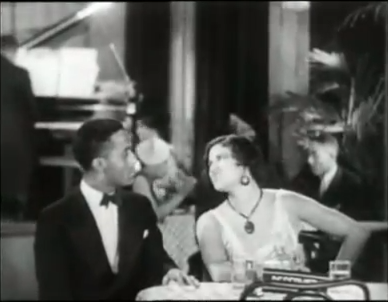
Quality shot (sarcasm) of Nina Mae McKinney as "Isabelle Walton".

The visual quality of this film was pretty bad also. This could be because of the film's age and lack of preservation, however. Plus, you would think that those in charge of the "look" of the film were scared of the location! According to IMDb, the movie was shot in Kingston, Jamaica, but we don't get too many broad, beautiful views of the land. If not for IMDb, I would have assumed that the movie was shot in the backyard of a Hollywood Hills resident.

However, the film does open with a group of people performing what appears to be a cultural song-and-dance, and that was pretty cool to watch. 


************

You won't be able to see their faces very well, but being able to hear the voices of and acknowledge the presence of some of American entertainment's forgotten stars (Nina Mae McKinney, Ida James, "Babe" Wallace) is quite a treat. Other than that, this movie isn't even average. It's pretty bad. Would I dissuade you from watching The Devil's Daughter? I wouldn't. Would I persuade you? Nope. 

Tuesday, May 21, 2013

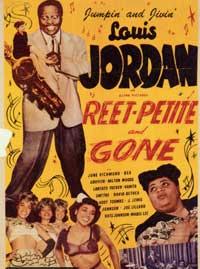
Movie of the Week: Reet, Petite, and Gone (Review)


Last night I watched our first "Movie of the Week", William Forest Crouch's Reet, Petite, and Gone! The film stars the Louis Jordan and features other entertainment greats like June Richmond, Lorenzo Tucker, Vanita Smythe, and Mabel Lee. 

SUMMARY

Old-time musical star Schyler Jarvis, now wealthy, is dying; his last act is a visionary plan for the future happiness of his son, swing bandleader Louis Jarvis, and Honey Carter, daughter of his long-lost love. But crooked lawyer Talbot has a nefarious scheme to get his hands on the Jarvis money...and it doesn't include any happiness for Louis and Honey. Plenty of swing from Louis Jordan's Tympany Five. [IMDb]

STORY 

The storyline was pretty simple, pretty predictable. If anything, the musical numbers often made you forget that a storyline even existed. 

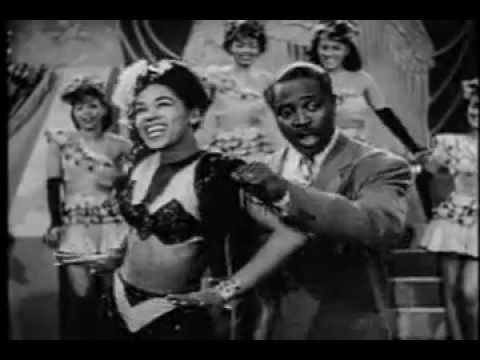
Bea Griffith and Louis Jordan as Honey Carter & Louis Jarvis


CHARACTERS/ACTING

Like the storyline, the characters' were pretty predictable. As with a lot of "race movies" (unfortunately), the acting in general wasn't particularly great, but three performers did play their roles well: the legendary Lorenzo Tucker, the unsung Vanita Smythe, and the film's star, Louis Jordan.


The legendary Louis Jordan

The great musician and bandleader, Louis Jordan, took on the hard task of playing a musician and bandleader in this film. No worries though, it was more than just "someone playing their self". Jordan was quite a natural in this role (especially compared to the other performers) and he delivered his lines flawlessly.

"Black Valentino" (Lorenzo Tucker)

What can I say about Lorenzo Tucker, one of early Black Cinema's biggest stars? Of course he was great in his role as the crooked lawyer, Henry Talbot. That's really all there is to it.


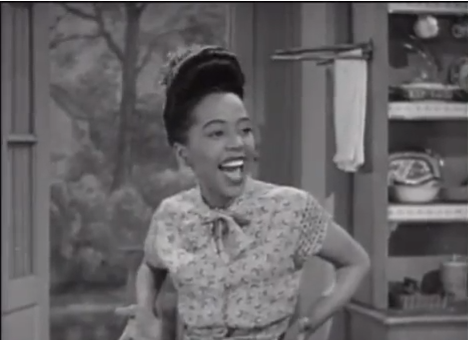
The unsung great, Vanita Smythe

Finally, Vanita Smythe. I'm actually a big fan of Ms. Smythe and her music and was disappointed to see that she didn't hum, sing, or whistle a thing! Nonetheless, the singer played the role of Rusty, Henry Talbot's secretary with subtle sultriness. 


DIRECTION

William Forest Crouch was a writer, producer, and director of many shorts and "soundies" and judging from his IMDb credits, this film is only one of two feature length pictures he's directed/produced. Mr. Crouch brought a lot of the soundie style to this film, but unfortunately--too much of it was brought. 


Click Here to check out "Back Door Man", a soundie starring Vanita Smythe and directed by William Forest Crouch. 


OVERALL THOUGHTS

Overall, I think Reet, Petite, and Gone is more of a talent showcase than it is a movie, but if you're a classic black entertainment enthusiast like I am, this isn't such a huge negative. Just don't expect a well-written story, that's all. 

You can watch Reet, Petite, and Gone on Youtube by clicking here


************

All of the above photos (with the exception of two) were obtained from Wikipedia. The photo of Bea Griffith and Louis Jordan was obtained from Youtube (via Google Image Search) and the photo of Vanita Smythe is my own screenshot from a Youtube video (now circulating on Tumblr and in Google Search results). 

If the rightful owner(s) of any of these images wants them removed, please contact me and I will do so immediately.--Adrienne


Wednesday, January 16, 2013

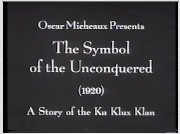
The Symbol of the Unconquered (Review)


I've finally finished watching Oscar Micheaux's fourth film--The Symbol of the Unconquered (1920) starring Iris Hall, Walker Thompson, and Lawrence Chenault. 


The Symbol of the Unconquered is one of Micheaux's earliest surviving works. It was discovered in Belgium's National Film Archives and although some of the footage is still lost, the film was restored by The Museum of Modern Art in New York (with the help of Turner Classic Movies). 

It was a bit hard for me to keep up with--probably due to some of the footage being lost, so in order to give this movie a thorough review, I will be breaking it down into some sections.

Monday, July 23, 2012

Classic Film of the Day: Hi-De-Ho (1947)


Today's Classic Film of the Day is the 1947 Cab Calloway film Hi-De-Ho. The film stars, of course, Cab Calloway, Ida James, and Jeni Le Gon and is based on the story out of Calloway's hit song "Minnie the Moocher".


Thursday, July 5, 2012

The Devil's Daughter (1939)


I am preparing to watch this 1939 film starring two of my favorite screen gems, Ms. Nina Mae McKinney and Ms. Ida James.

Can't wait to watch it and tell you all what I thought of it!


Tuesday, June 5, 2012

Dirty Gertie from Harlem U.S.A. (ALF Review)


While watching this movie I decided to read about it a bit and I also read about the director, Spencer Williams.

I read a few things saying that Spencer Williams' directing and filmmaking has been criticized--basically for its low production and lack of camera angles, stuff like that--but if anybody knows anything about American history, American Film History, and "race films", they may easily come to the conclusion that Spencer Williams may have had little to work with and that most "race films" were low-budget, dark, and have been poorly preserved. (Wikipedia page on "Race Movies")


(Click 'Read More')


Monday, June 4, 2012

Wednesday, May 16, 2012

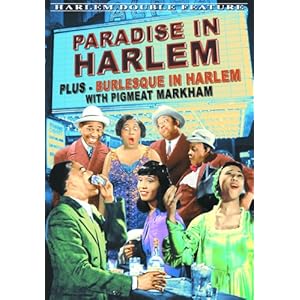
Adrienne Likes...Paradise 'n Harlem


When watching this movie, I immediately had to put myself in a 1930s, "race film" mindset. I was first hit with a name on a marquee in the beginning of the film had a band named "The Cotton Pickers". Just when that sunk in, I had to wrap my mind around the fact that the main character--Lem Anderson (played by Frank H. Wilson), a performer would be doing most all of his performances in blackface (we never see him perform actually, just getting ready for performances). I understand that times and things like that usually don't bother me and it didn't this time; I was just thrown off a little bit.

One must understand that "race films"--films created with all-black casts for black audiences were usually low-budget films. Most times they were produced and directed by white men, other times they were directed, produced, and written by black men, like Oscar Micheaux. Frank H. Wilson, who as previously was the star of Paradise in Harlem also wrote the original story, but the story would be written for the screen by a Vincent Valentini and directed by (based on his credits, I want to assume he was Jewish) Joseph Seiden. I'd like to think that Wilson's story was bent all kinds of ways for the script, but I can't say I know this for sure.

Along with the blackface and "Cotton Pickers" band, I also noticed that when scenes were set in Harlem in this film, the majority of the women in the scenes had fair/yellow skin, which was typical in black cinema of the past. However, when scenes were set in the South, there were plenty of brown/dark women! I found this strange, but hey, what the heck. After these scenes, when we return to Harlem, more brown women showed up. This was sort of strange to me and I wanted to point it out.

I must say, I was easily distracted while watching this movie. I believe it may be easy to be distracted when watching movies on the internet though. The movie had a great storyline and could have been made into a big motion picture, but unfortunately race got into the way of that, therefore money got in the way as well. There were some parts in the film that were somewhat unrealistic (too focused on wanting the colored people relate I guess)--like an audience breaking out into song-and-dance in the middle of a play o_O and not just any play--Othello.

Despite the small cloud of racism that hung over the film, I did like the movie and its potential. I understand the time in which it was made and how it was made, but perhaps if it were made just a few years later when Stormy Weather and Cabin in the Sky and other all-black cast films like that were being made during the 1940s, it would have been a success. 

I did enjoyed the film's music! Blues great Mamie Smith graced the movie with her voice and so did singer Juanita Hall in the end (with one of my favorite hymns "By and By 'Til the Mornin' Comes" and another song--both in that unnecessary break into song-and-dance I talked about). 

The acting in the film was great as well! There was a little bit of coonery from some characters, which is expected as I stated before, but they played their parts *shrugs*. I must tip my hat to the black actors who paved the way for black actors of today by taking on such roles. Everyone was great in their role, but I was especially impressed with Norman Astwood's performance as the macho gangster; and Merritt Smith's performance of a loving and concerned nephew. This was also my first time seeing Francine Everett's acting as well, something I've been really anxious to see. She was great in her role and has a beautiful singing voice!

However, the people who stuck out to me the most: The Alphabetical Four! The four man singing group sang with Mamie Smith in a scene and their harmony was beautiful. I plan on learning more about them and finding more of their music.

I'd give Paradise 'N Harlem (or Paradise in Harlem) 2 1/2 out of 4 stars and I'd recommend it for those who are interested in Film History, Black History, and Black Film History. It was quite an interesting watch.