Welcome to People of Color in Classic Film--a blog dedicated to People of Color who made contributions to (particularly, but not exclusively) American film and television between the Silent Era and 1980.
This is the last four slideshows for my race-bent casts of some of my favorite classic movies--all featuring June 2015's Star of the Month, Nina Mae McKinney as a cast member. Below is a slideshow of a race-bent cast for That Uncertain Feeling (1941), the filming starring April 2015's Star of the Month, Merle Oberon.
It isn't hard for me to lament over the roles that "could've been" for Hollywood's first black leading lady, Nina Mae McKinney. I'm constantly watching classic movies and thinking, "Hmm, -person of color- would have played this role..." but I digress...
Below is the first of four slideshows with a race-bent cast for some of my favorite Hollywood classics (all featuring our Star of the Month):
The next slideshow will be posted on Monday, June 22nd! :)
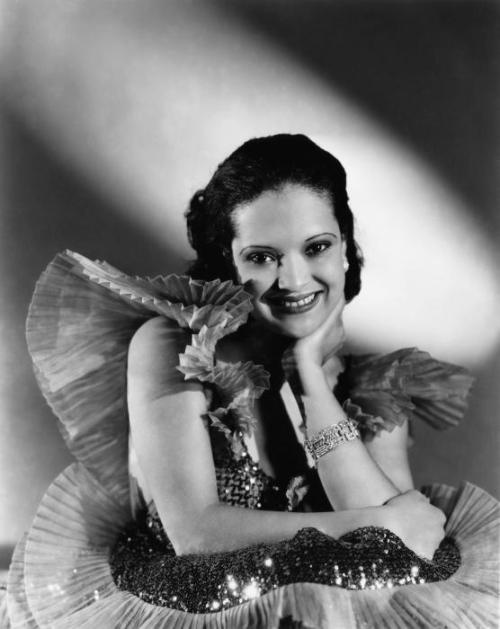
Today marks 103 (or 102, depending on your source) years since the birth of Hollywood's first black leading lady, Nina Mae McKinney.
Nina Mae McKinney was born Nannie Mayme McKinney on June 13, 1912 in Lancaster, South Carolina. Below are links to "everything Nina Mae McKinney" available online: *Also, some sources list McKinney's birthday as June 12th*
************
Cinema
1. Nina Mae McKinney made her screen debut in King Vidor's 1929 film, Hallelujah!. The role of "Chick" was the first leading role for a black woman in a Hollywood film. You can click here to watch Hallelujah! in its entirety on YouTube.
2. McKinney received rave reviews for her performance in Hallelujah! but subsequent roles were limited and few. Her next role as a "Singer/Dancer" in the MGM short, Manhattan Serenade (1929). Then, in 1930, McKinney played the uncredited role of a singer in They Learned About Women.
*Manhattan Serenade was long thought to be a "lost film", but was found in 2014 and screened at the Film Forum in New York City on November 9, 2014. If you live in or near New York, you can catch a screening of it at the MoMA.*
3. McKinney's next (and more significant) role came with the 1931 Pre-Code gem, Safe in Hell. I've inserted two YouTube clips of our Star of the Month as "Leonie - the Hotel Manager":
[Clip 1 - Nina Mae McKinney introduces the song "Sleepy Time Down South"]
4. Nina Mae McKinney appeared in a couple of shorts in 1932--Passing the Buck and Pie, Pie Blackbird. You can watch Pie, Pie Blackbird below:
5. Like a lot of entertainers of color, Nina Mae McKinney would leave Hollywood to try a hand at success in Europe--and she was successful in her attempt! It was there that she was dubbed "the Black Garbo". Click here to watch a clip of her performing in a London nightclub.
6. McKinney's next major film appearance was alongside Paul Robeson in the London Film Production, Sanders of the River (1935). Watch the full movie on YouTube by clicking here.
7. Get a glimpse of Nina Mae McKinney in the 1935 film, Reckless(starring William Powell and Jean Harlow). The trailer for the film is below:
8. In 1936, McKinney made an uncredited appearance in The Lonely Trail and also appeared in the musical short, The Black Network:
You can find more of Nina Mae McKinney's film credits on IMDb. Below are two additional movie links (both leading to YouTube):
Nina Mae McKinney starred as "Isabelle Walton" in the Sack Amusement Enterprises pictures, The Devil's Daughter (1939).
Nina Mae McKinney played the role of "Rozelia" in Pinky (1949), a 20th Century Fox film.
************
Music
Nina Mae McKinney introduced Irving Berlin's "Swanee Shuffle" in Hallelujah!. Watch her lively performance of the tune below:
In the early 1930s (circa 1932), McKinney recorded a few songs with jazz pianist, Garland Wilson's accompaniment. Among the known recordings are "Rhapsody in Love" and "Minnie the Moocher's Wedding Day".
Nina Mae McKinney: The Black Garbo is the first--and currently, the only--biography written about Nina Mae McKinney. It was written by famed biographer Stephen Bourne and published in 2011. Mr. Bourne himself has admitted that The Black Garbo wasn't his best work, but again, the biography is still is the first and only attempt at telling Nina Mae McKinney's life story, so far.
"A Jungle Lorelei" (Photoplay- July 1929) Yep. That's the title. Writer Herbert Howe wrote an article on the 17 year old Nina Mae McKinney for the July 1929 issue of Photoplay magazine (a month before Hallelujah!'s theatrical release). Click with caution--the actual article gets no better than its title.
As a child, Nina lived with her "Aunt Carrie" while her parents moved to New York. I believe this may be a record of who "Nannie Mayme" lived with as a kid. The woman of the house is listed as "Galie McKinney"--perhaps Carrie's name was accidentally heard as "Galie"? McKinney was briefly married to trombonist Jimmy Monroe in the 1930s. This may be a record of their marriage. Based on previously shared news articles, Nina Mae McKinney lived with her parents (specifically noted, her mother) for a long time. When her mother passed away in 1962, she was living with her. Here is a 1940 Census record that may list Nina as the "daughter" of James Maynor and Georgia Crawford. Many online sources state that Nina Mae's father was Hal McKinney, leading me to believe that her mother may have remarried at some point. ************ I hope you find this appreciation post to be quite an educational one! Please, feel free to share!
I've been avoiding this post for months because I'm always so adamant on actors looking exactly like the people they're portraying, but...it's time for me to go on and let that go and post "Biopics We Need (Men)" before 2013 ends! Check out my choices in the slideshow below!
Check out Biopics That We Need! (Women) from March 2013. *Created in place as a substitute for this month's That's Old News! segment*
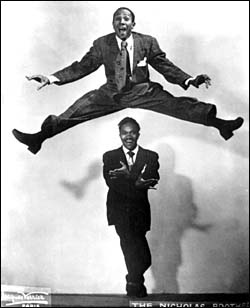
From Theatre Dance, Fayard (in the air) and Harold Nicholas
I...love...The Nicholas Brothers. I love them. If I were a dancer, I would aspire to be like them. In my opinion, they were, are, and forever will be the greatest dancers to ever walk this Earth--period. If you don't know who The Nicholas Brothers are...
************
First off, here are some links for you to check out:
Check out young Fayard and Harold performing in the musical short, Pie, Pie Blackbird (1932).
Watch the dynamic duo a few years later in The Black Network (1936). Actress Nina Mae McKinney starred in both of these shorts, by the way.
Watch The Nicholas Brothers in a scene stealing (and uncredited) performance in Down Argentine Way (1940).
Harold Nicholas performs with his big brother and fiancée (Dorothy Dandridge) in this "Chattanooga Choo Choo" routine from Sun Valley Serenade.
Below is THE greatest dance routine of ALL time--the infamous and incomparable "Jumpin' Jive" number in Stormy Weather (1943).
Here they are performing on The Colgate Comedy Hour in 1952...
...and at the Hollywood Palace in 1965!
Harold Nicholas is the fifth "challenger" in red in this scene from the 1989 movie, Tap. However, I highly recommend that you watch the entire clip!
Now, watch Fayard Nicholas perform Duke Ellington's "It Don't Mean a Thing (If It Ain't Got That Swing)" at Los Angeles' famed Improv in August 2002.
************
There are many more clips and links available to us through a click of a mouse. Please share this post and continue sharing the legacy of the late, great Nicholas Brothers.
If you've read the 'About Me' section of this blog, you'll know that I'm born and raised in Virginia--Richmond, Virginia to be more specific--"Cap City", Capital of what used to be known as "The Confederacy". We've got a memorial to Jefferson Davis, statues of Generals Robert E. Lee and "Stonewall" Jackson, and also a memorial dedicated to the late tennis great, Mr. Arthur Ashe.
Arthur Ashe Memorial
Richmond, Virginia was also home to two legendary pioneers of entertainment: Bill "Bojangles" Robinson and Charles Sidney Gilpin.
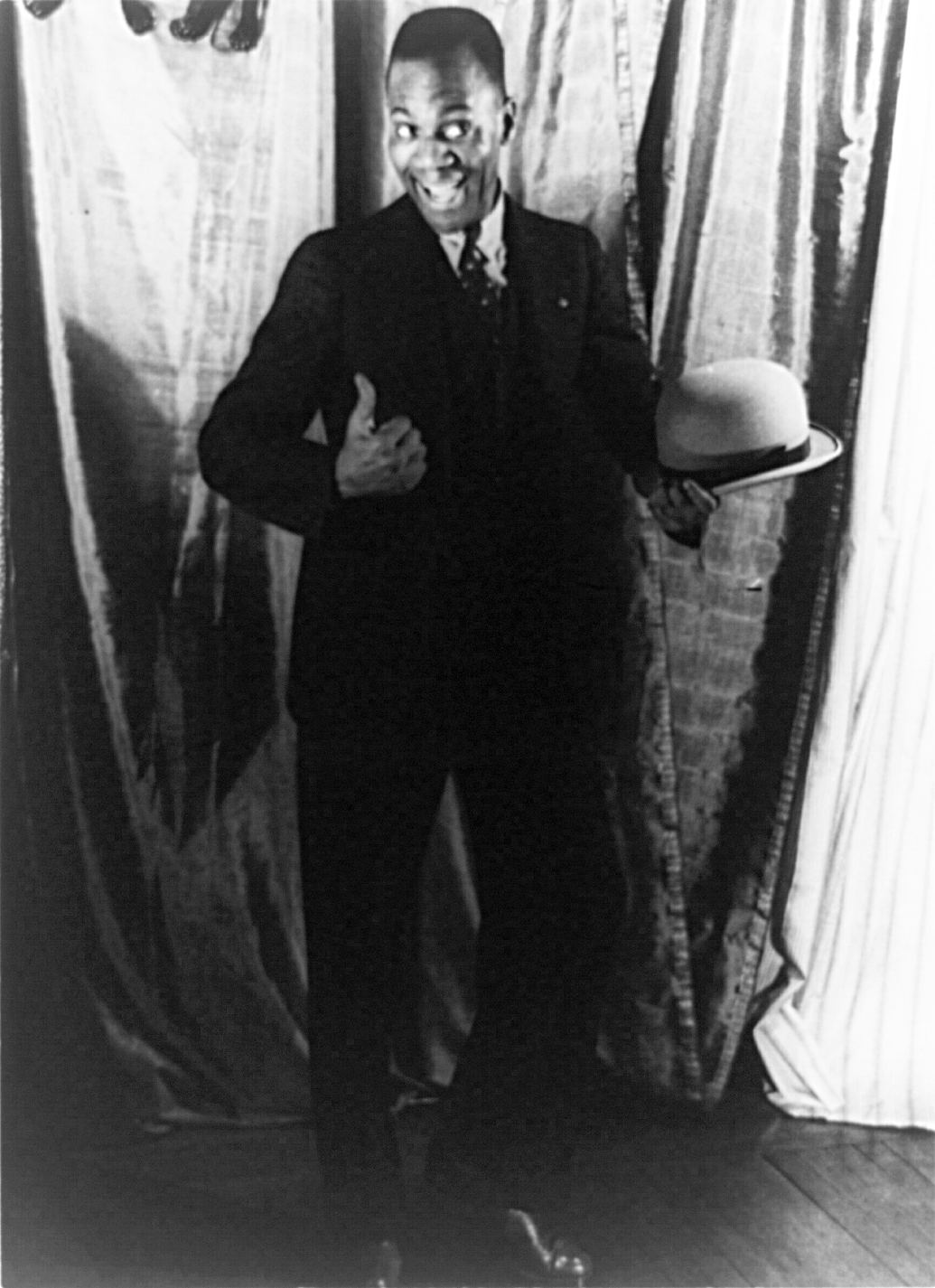
Bill "Bojangles" Robinson
"Bojangles" was born Luther Robinson on May 25, 1878 in Richmond, Virginia. In 1885, both of his parents died--his father from chronic heart disease and his mother from natural causes--leaving Luther and his younger brother, William to be raised by their grandmother, Bedilia, a formerly enslaved woman. Ms. Bedilia was ill and unable to raise the boys (and according to some sources, she wasn't interested in raising them either).
How did Luther Robinson become Bill Robinson?
Luther Robinson actually hated his birth name and legend has it that he bullied his little brother, William, into giving him his name--thus, at a very young age, Luther Robinson became Bill Robinson (and William changed his name to Percy). Bill Robinson began dancing--"hoofing" rather--at local beer gardens and he soon dropped out of school to make a career out of his hobby. By the time he'd reached his mid-late teens, Bill Robinson had become a hard-working vaudevillian.
************
Even through serving in two wars (first as a drummer boy in the short Spanish-American War of 1898, later as a rifleman during World War I), Bill Robinson's career gradually blossomed throughout the early half of the 20th century. He'd gone from being a vaudeville favorite to a Broadway favorite--and later would become a beloved on-screen performer.
Watch Mr. Robinson do his famous "Stair Dance" below:
Bill "Bojangles" Robinson died on November 25, 1949 of heart failure. He was 71 years old.
His funeral was arranged and paid for by his friend, Ed Sullivan (Mr. Robinson had fallen on hard times in the later years of his life) and held at the 369th Infantry Regiment Armory near Harlem (the Infantry he served with during WWI). About 32,000 people attended the services and the eulogy--given by Adam Clayton Powell, Sr.--was broadcast over the radio.
************
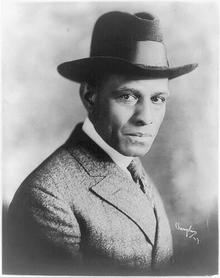
Charles S. Gilpin
Charles Sidney Gilpin was born on November 20, 1878 in Richmond, Virginia. Before finding a career in theatre, young Charles had found work as an apprentice for in the Richmond Planet print shop. At the age of 18, he left Richmond to join pursue a long-lasting stage career. However, like other performers, he had to work odd jobs for financial stability. While establishing a career as an actor, he also worked as a barber, a printer, a boxing trainer, an elevator operator, and a railroad porter. He also sang in a few choruses.
Charles Gilpin began taking on dramatic roles in 1907 when he performed with Robert Mott's Pekin Theater in Chicago. Then, he left Robert Mott's Theater in 1911 to tour the US with the Pan-American Octetts. In 1915, he joined the Anita Bush Players (later known as The Lafayette Players--a stock company that would help to launch the careers of many black actors, including Gilpin). A salary dispute would cause Mr. Gilpin to leave Bush's company, but his reputation with them would garner him roles on Broadway. First (in 1919), he was hired to play the role of Rev. William Curtis in John Drinkwater's play, Abraham Lincoln and soon after, he was cast in his defining role--the lead in Eugene O'Neill's The Emperor Jones.
The 1920 role of Brutus Jones made Charles Gilpin a Broadway star. It also made him the first African-American to be named by the Drama League of New York as one of ten people who'd done the most for American theater that year. In 1921, he was awarded the NAACP's Spingarn Medal and was also honored at the White House by President Warren G. Harding. In 1922, the Dumas Dramatic Club (now known as the Kamaru Players) of Cleveland renamed itself the Gilpin Players.
Unfortunately, when The Emperor Jones closed on Broadway after 204 performances, Charles and Eugene O'Neill began having a dispute over the constant use of the word "ni**er" in the play. Gilpin insisted that O'Neill change the word and O'Neill refused. When The Emperor Jones was revived in 1924, Charles Gilpin was replaced by up-and-coming entertainer Paul Robeson.
The disappointment of losing his landmark role drove Mr. Gilpin to drink. Although he worked in two films in 1926 and 1927, he never worked on the Broadway stage again. His health declined rapidly and he passed away on May 6, 1930 in Eldridge Park, New Jersey. He was 51 years old.
The Scar of Shame (1927) featuring Charles Sidney Gilpin is currently available on Youtube.
***********
The Richmond Natives Honored:
In 1933, while visiting his hometown of Richmond, Virginia, Bill Robinson spotted two children who were having a hard time crossing the street to retrieve a ball. Witnessing this made Mr. Robinson pay to have a stoplight installed at the intersection. A statue dedicated to Mr. Bill "Bojangles" Robinson was sculpted in aluminum by Jack Witt and erected by the Astoria Beneficial Club at this same intersection (on the corner of Leigh and West Adams streets) in 1973. You can ride down this street today and see "Mr. Bojangles" smiling at you.
Gilpin Court, the public housing projects in Richmond's Jackson Ward neighborhood were completed in 1943. My own paternal family is deeply rooted in the great Jackson Ward area, as well as in and near the public housing apartments named after Charles Sidney Gilpin. There's been a lot of talk about redevelopment over the years--as it usually is for areas like this.
I hate to get political all of a sudden, but if you ask me, not only do the people of the once-thriving area deserve better, but the legacy of Charles Gilpin deserves way better as well. That's all I will say.
************
All of those interested in American History, Black American History, Entertainment History, Black Entertainment History, etc.--come visit my hometown of Richmond, Virginia. Go ride through the Historic Jackson Ward area (you should visit during the annual 2nd Street Festival) to see where legends were born and where legends grew up.
Special thanks to one of my high school teachers, a commentator and follower of this blog who gave me the inspiration and idea for this post! Thanks for following, Mr. Smith!
************
I do not own any of the photos in this post. In order to credit the sources in which I obtained the above photos, I added custom watermarks with their URLs. Photos without watermarks were obtained from Wikipedia. If the rightful owner(s) of any of these images wants them removed, please contact me and I will do so as soon as possible.--Adrienne
We all the know of Classic Hollywood's dynamic duos (and some trios): Laurel and Hardy, Abbott and Costello, The Three Stooges. Here are some other great teams that I'd like for you all to check out: ************
Above are two clips of Mantan Moreland and Ben Carter bringing their hilarious vaudeville act to the screen in Charlie Chan films.
Mantan Moreland was one of the most popular comedians of the 1930's and 1940's. He is probably best remembered as Birmingham Brown, the chauffeur in the Charlie Chan series.
Ben Carter was also a comedic actor as well as Black Hollywood's premier agents. He cast the black performers in A Day at the Races and those (except for Hattie McDaniel, Butterfly McQueen, and Eddie 'Rochester' Anderson) in Gone with the Wind.
************
Here is "Buck and Bubbles" (Ford L. "Buck" Washington and John William Sublett) in Varsity Show (1937).
The music-and-comedy team worked in about 14 films together, appeared in the Ziegfeld Follies of 1931, and were the first black artists to perform at Radio City Music Hall.
Unfortunately, the duo came to an end when "Buck" Washington passed away in 1955.
************
I'm a HUGE fan of The Nicholas Brothers and a big fan of their "Jumpin' Jive" routine from Stormy Weather, but check out how great these brothers were even as kids. This number is titled "Lucky Number" from a musical short titled "The Black Network".
************
Check out this amazing trio--The Miller Brothers and Lois. This is the only footage I've ever seen of this group (from the 1947 Cab Calloway film Hi-De-Ho). They're right up there with The Nicholas Brothers with me.




.jpg)


.jpg)


